
Giving Single-Store Operators the Competitive Edge
- Post author By 206340pwpadmin
- Post date
Andrew Russell
President, Sound Payments
With the EMV mandate and other factors like the COVID-19 pandemic, the petroleum industry has seen first-hand that the technological world is changing.
What has worked for years is no longer a reasonable option. With the constant improvement of technology, merchants and consumers need a platform that can keep up with developments.
Merchants value convenience, easy management of business operations and purchases while consumers value convenience and easy-to-use interfaces for their interaction. There is a higher need for smart, connected devices to transform the management of a store and keep the competitive force in business. This is especially true for smaller retail chains and single-store operators.
According to NACS, currently in the US there are 116,641 convenience stores, 60.4 percent of which are single-store operators and 55 percent of which are independent from major oil. Independent stations across the country are working hard to run their business and keep it going, especially amid all the changes from Covid-19. The liability shift has been a challenge for many whether that is due to chargebacks or struggling to figure out how to update their pumps for EMV.
Over the past year, the petroleum market saw a 3.1 percent decrease in single-store operators. According to NACS, the decrease continues the multi-year trend of the shrinking market. 2021 had the lowest metric for single-store operators in 16 years.
Global computing costs are declining rapidly, and traditional operational costs are increasing. Transitioning business operations onto the cloud is the next step to becoming competitive in this market for single-store operators.
But how do you take the limited resources of a small business and enhance their stores to compete with the major oil brands? The answer is IoT.
“Internet of Things” (IoT) refers to sensors or devices connected to the internet that collect, transmit and receive data controlled by a single application. This app allows for many services, including setting up subscription-based payments.
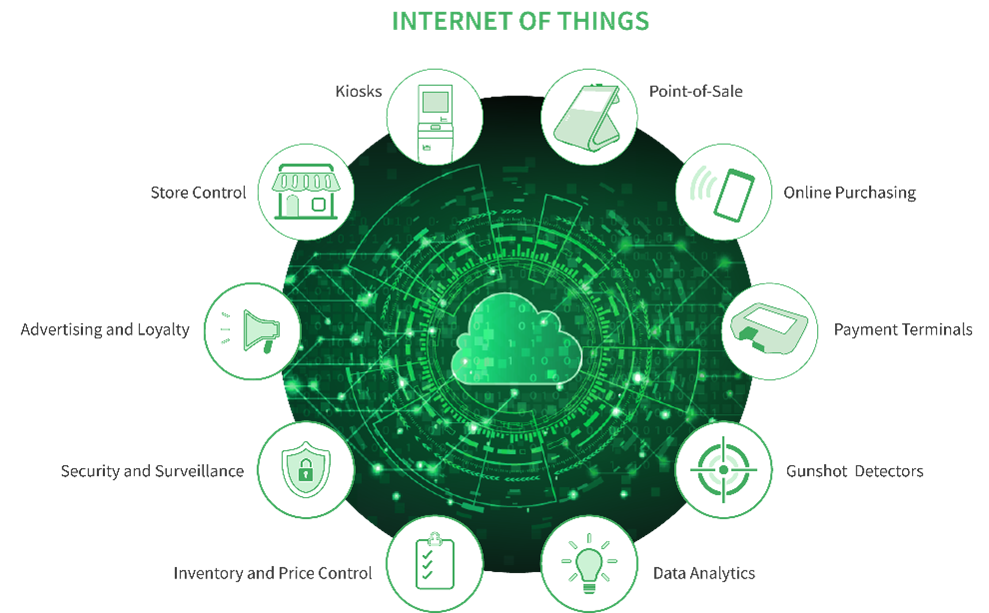
The IoT ecosystem comprises ten devices and sensors that work together to create a seamless experience for the consumer and merchant alike by connecting everything via the cloud. The cloud allows additional solutions that work seamlessly together in real-time. Let’s take a deeper look into how they work together:
- Kiosks: Free-standing payment acceptance hardware and software – positioned between two pumps so that it can serve both or for car wash facilities at stations.
- Point-of-Sale: A POS platform that gives retailers all the features they have come to expect.
- Payment Terminals: All businesses need a way to accept payments in-store, at the pump and the car wash facility.
- Online purchasing: Improve the customer experience and store sales by giving customers another reason to choose YOUR station – the convenience of ordering at the pump or via the customer app rather than waiting in line in the store. App also allows for subscription-based payments for items or products in the store.
- Security and Surveillance: Surveillance cameras are embedded inside the payment module.
- Gunshot Detectors: Alsoa part of security, but ads an additional layer. Owners are immediately aware if a gunshot is detected in or around their store.
- Data/Analytics: Management has powerful data and customer insights for better decision-making to increase revenue.
- Inventory and Price Control: Electronic shelf label (ESL) and back-officeshelf systems track all the products/inventory in the store.
- Advertising and Loyalty: The payment terminals can display advertising and upsell in addition to connecting with loyalty programs via our cloud.
- Store Control (power outlets, thermostats, time clocks, digital signage): Store owners can have greater control and efficiency over their store by managing power, thermostats (including cooler temperature sensors), time clocks, digital signage and other store operations via the merchant app.
Businesses using an IoT ecosystem can diversify their limited resources with a more efficient operation. Retail businesses already pay subscription fees for many products and services, but they use old and disconnected technology. IoT enables them to integrate and streamline their business and lower operating costs.
IoT benefits small businesses as it increases their operational power. Because of limited resources, small businesses must prioritize what they choose to spend. Additional operations such as online purchasing or advertising are lower priorities than point-of-sales and payment terminals. IoT can add new business and sources of revenue by driving people to their station because of better, seamless, and convenient customer solutions.
Apps like GasBuddy allow drivers to choose a station based on specific criteria. Drivers can select a station that provides order at the pump using selection criteria on GasBuddy.
For instance, truck drivers have to wait 15 minutes or more while they pump gas and can’t leave the pump. The same goes for individual consumers as well. By the end of that time, the last thing they want is to go inside and wait in a long line. With the online purchasing feature, they can use this valuable time to purchase items either through the mobile app or at the pump. Additionally, the device at the pump would allow for advertising and special promotions connected with the inventory and pricing management solution in real-time.
By investing in smart technology, your business runs smoother, and you look better for your customers. By providing more options for customers to interact with your business, you’ll retain loyalty and increase revenue. For any questions on the IoT, please reach out to us at 904-319-6503. Sound Payments is a technology company developing cost-effective solutions for independent stations across the U.S., including its EMV solution, Sound Easy Pump.
Related Posts
The American Digital Payments Revolution
Andrew Russell President, Sound Payments The American Digital Payments Revolution began in the mid-1990s and gradually evolved over time. However,
A Focus on Fintech During Changing Times
By Andrew Russell, President of Sound Payments – Originally published on the American Bankers Association Industry Insight As we consider